Архивы автора: Elena

Евгений Малых. Художник (2024-05-11 16:18:02 GMT+03:00)

Давайте отправимся на пленэр! На свежий воздух,на природу — погрузимся в мир творчества.🎨
Пленэр — это удивительное приключение, которое позволяет нам изучать окружающий мир через призму искусства. 🖌
Почувствуйте вдохновение и ощутите волнение от создания произведения искусства вне стен мастерской, в объятиях природы. ☀🌹🌷
Путешествие на пленэр открывает новые горизонты и дает возможность реализовать свои творческие идеи в необычной обстановке.
Войдите в этот удивительный мир и насладитесь моментами творческого вдохновения! 🖼
#spring #plenair #painting_in_the_open_air #весна #пленэр #творчество


Евгений Малых. Художник (2024-03-08 01:12:47 GMT+03:00)

Дорогих женщин поздравляю с Международным женским днём 8 марта! Под впечатлением от выставки «Свет и воздух. Традиции импрессионизма в советской живописи», которая проходит в Музее искусства Санкт-Петербурга XX- XXI вв. по адресу наб. Канала Грибоедова, 103. Очень советую посетить, так как до её закрытия,15 марта осталась ровно неделя. Всей нашей прекрасной половине желаю счастья, здоровья и уверенности в будущем.


Видео от Евгений Малых. Художник

Евгений Малых. Художник (2024-03-03 16:58:52 GMT+03:00)

28 февраля исполнилось 111 лет со дня рождения Анны Ивановны Зеленовой, легендарного директора ГМЗ «Павловск» и удивительной женщины, без которой возрождение этого чуда вряд ли было бы возможным.
Она и её единомышленники сделали всё, чтобы люди приходили в парк, посещали музей, радовались жизни. Если бы Павловский парк не был бы возрождён, не было бы и большей части моих работ. Павловск — гордость нашей культуры, любимое петербуржцами и гостями нашего города место отдыха, а также неиссякаемый источник вдохновения для творческих людей.
Жизни и деятельности Анны Ивановны Зеленовой посвящена моя статья.


Удивительное рядом. Мемориальный музей А.И.Зеленовой в Павловске | Волшебный мир пленэра. Картины ху

https://evmal.ru/udivitelnoe-ryadom/

Статья посвящена деятельности Анны Ивановны Зеленовой на посту директора Павловского музея-заповедника. T

Евгений Малых. Художник (2024-03-01 19:10:33 GMT+03:00)

Здравствуйте! Я рад приветствовать вас на официальной странице моего сообщества В Контакте. Дата его появления не случайна — 23 февраля 2024 года. Помимо того, что это День защитника Отечества, это ещё и день моего рождения. А для меня это и повод для создания новой платформы для общения со зрителями. В этом видео я решил рассказать о том, что люблю: пленэр, живопись, преподавание. Постарался сделать краткий, импрессионистический видеоочерк. Главное — позитив.
Смотреть этот же ролик на Youtube:
https://youtu.be/EEPehA-_VEA


Евгений Малых. Удивительный пленэр


Евгений Малых. Мой пленэр. Evgeny Malykh. Painting in the open air

Pavel Chistiakov as an individual, artist, and a mentor

Three years running, I am going for my summer open-air sessions to the town of Pushkin, former Tsarskoye Selo. This name of the town is the one I’m more familiar with because it is initially given to this city and historically more consistent. In addition to this, the town of Tsarskoye Selo is called Muses’ town. It’s true, the muses favoured creative people: poets, artists, writers, architects, and musicians. Near the Lyceum, where Alexander Sergeevich Pushkin studied, the stone with the inscription «To the Genius of the Place» has been installed. Indeed, if the genius of this place does exist, it embodies the spirit of creativity.
There are many places in the town of Tsarskoye Selo, which are closely related to the presence of the famous people — scientists, writers, poets. One of them is the House Museum of Pavel Petrovich Chistiakov located on the Moscow Road (former Fridental Colony). The settlement of this area began in the years of 1816-1827. Due to the census of 1897, there were 228 people living there, most of whom were artisans who produced haberdashery: ribbons, laces, tapes. The Moscow Roadway is an old road which led from Tsarskoye Selo to Moscow as opposed to a straight road which came through Slavianka to Izhora. A trip on this road was allowed only to those people who had the right to do that or had an urgent need. Behind the Moscow Gates, there was an outpost. On one side of the road (on the left if you are back to the Gospitalnaya street), there were the houses of colonists while on the right there were the country houses of wealthy people.
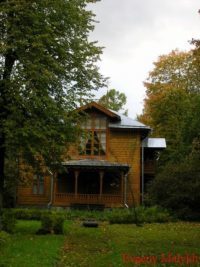
In one of these houses, lived Pavel Petrovich Chistiakov, who, according to Vladimir Stasov, was the teacher of all Russian artists. He lived there from 1876 to 1919, until his death This country house (dacha), later the artist’s residential home, was situated in the amazingly picturesque settings. Between the Pavlovsk roadway and the Moscow roadway, there was the Separate (Otdelny) Park designed in the style of English landscape design. Here there is the extensive Colonist Pond and the dacha of Grand Prince Boris Alexandrovich, built as an English cottage. For Pavel ChistiakovTsarskoye Selo and its surroundings had been quite familiar. Before the construction of his big country house, Pavel Petrovich had had a small home in one of the villages near the town of Pavlovsk. The dacha next belonged to V.V.Deriker, who was a prominent homoeopath in St.Petersburg and the stepfather of the painter’s future wife V.E.Meier-Chistiakova. Later on, N.I.Vavilov, a distinguished scientist and geneticist lived in this country house.
The dacha of P.P.Chistiakov was designed by A.H.Kolb, the architect who was a former student of A.P.Briullov. Nevertheless, the artist himself and his wife Vera Egorovna were very much involved in the creation of the exteriors of this house and its interiors. Wood carving on the facade, a weather-vane and the ceiling painting in the dining room — all these elements of decorum were included in the composition of the house by the architect who was influenced by the artist’s ideas. The idea of the additional entrance to his studio from the street also had come from Pavel Petrovich; similarly, the wishes of the artist were implemented by the architect when the studio was being designed.
Pavel Petrovich and his family lived in this house for decades. The walls of this house witnessed many events; many people have been here. This house made a good impression on people. It looked like the house whose residents lived in plenty. A large circle of friends and family gathered there. But above all, anyone who needed help and support could get them in this house. The doors of this house were opened to all in need. Many artists, scientists, and writers were here such as V.E.Savinsky, N.A. Bruni, A.A.Rizzoni, A.L.Ober, N.A.Laveretsky, A.P.Karpinsky, I.V.Ershov. The family members of the families of D.I.Mendeleev, O.D.Forsh, and I.I.Sreznevsky used to visit the house of Pavel Chistiakov. Next to Pavel Chistiakov’s house there where the houses where lived the artists M.N.Vasiliev, K.A.Gorbunov and sculptor M.V.Kharlamov.
Pavel Petrovich and his wife Vera Egorovna, who possessed great artistic abilities, were the heart and soul of this house. Her self-portrait painted in the years when she was young, we can see in the dining room. However, the young artist didn’t go on the path of developing her talent, totally dedicating herself to her family. In 1928, Olga Forsh, the famous Soviet writer, and S.P. Yaremich, the art historian, wrote a book about Pavel Chistiakov. Olga Forsh describes the dining room: «The table, narrow and long; in the dining room, created according to the design of Pavel Petrovich, there are the walls panelled with white wood. In the middle there is an arch: green ivy, covered it, creeping down on the white windows». [3.298]
Quite often many people gathered at the table in the dining room. O.D.Forsh tells us that the artist had a great pity for people. Apart from his countless relatives from the Tver region, many strangers, including teenagers, always lived in the house.» [3.298]
Next door to the dining room is the living room. The decoration of its interior gives a complete picture of the lifestyle of intelligent people in the 19th century. There are the photos and pictures of Pavel Petrovich and Vera Matveevna Baruzdina, his disciple and niece. Pavel Petrovich was of the high opinion of his niece’s talent. He said that the only two people who mastered his artistic and pedagogical system were Valentin Aleksandrovich Serov and Vera Matveevna Baruzdina.
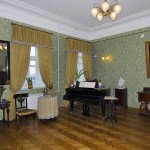
One can imagine how the evening parties passed in this living room: somebody was playing big piano, the music was playing and the guests were having the nice conversations looking at the photos in the family album. The next room is a small living room. This room gives us the information about the friends of Chistiakov. There are the portraits of the writer Olga Forsh, J.V.Durdin, the artist’s nephew and many other people who were close to Chistiakov’s family on the walls. Nowadays temporary exhibitions of contemporary artists are being arranged in the small living room.
It goes without saying, the artist’s studio itself is the «holy of holies» at this home. Well light and thought-out, this studio was designed according to the wishes and needs of the artist. The light penetrates into the room from the huge window looking to the Moscow road and from a smaller window on the next wall. This room looks like it is filled with air, and it’s easy to breathe when working in it, and you want to create something beautiful. Many paintings that are created in the different years can be seen here on the walls of this room.
The portraits of an Italian girl, a custom-made picture of a woman and a male portrait are among them. Two of his pictures draw our attention: it is «The Blessing of Children» and the portrait of the mother, which is painting with great love, attention to a detail and great mastery. Before the renovation of the museum, which began in 2006 and finished only in summer 2009, visitors could just see the canvas «The Last Minute of Messalina, the Wife of Emperor Claudius.» This painting was supposed to be some sort of a report on his training experience in Italy. The artist had been painting it for many years, but, unfortunately, he did not finish it for many reasons, and still, it remains as the study guide on how to create a picture of a large size. All stages of this composition can be seen. When the museum building was renovated, the picture was taken to the State Russian Museum for the restoration, and due to the fact that the size of this canvas didn’t allow it to be transported in a usual way, in other words, to be taken from the studio on the canvas stretcher, the picture had to be taken from its canvas stretcher and wind on the roller. When it had been restored, therefore, to bring it back, it was necessary to take it again from the canvas stretcher that would make no sense and the colourful layer would be damaged. So, the master’s work remained in the Russian Museum.
The artist’s studio is a place where he stays alone with himself and his images which then enter the world and become close to a spectator. However, Chistiakov gave his heart and soul to people not only by delivering his ideas through his pictures. Today he would have been characterized as a teacher God gifted teacher. At the time he had come to St.Petersburg, he entered the Academy of Arts. He was pretty young. Not only did he set a goal just to gain professional knowledge and acquire skills which were so necessary for him as a professional artist, but do deal with many other mundane goals. He had to solve such issues as how to get by in the capital, to make a living, and more importantly, save the money which he had earned. Pavel Petrovich lived far from the Academy, near the Alexander Nevsky Monastery. There were days when he had to walk about 30 miles, saving the money for a cabman. In addition to this, he had to visit his students at their home and give them lessons on drawing.
Paradoxically, teaching began to play a totally different role in his life. It had become the area of his expertise. In addition to his private lessons, he had classes at the School of the Arts Promotion Society. The pedagogical activities of Pavel Petrovich were not always in favourable conditions. For a long time (about 20 years) he worked at the Academy as an Associate Professor, Assistant Professor, Professor on Duty. And only in 1892, he received the rank of the Second Degree Professor. However, he didn’t have an official personal studio where he could teach students. His classes on drawing, arranged in his home studio, were free of charge for the students. He attracted the attention of many people. He was highly respected by many artists, who had graduated the Academy and then took lessons from him. One of his students was Ilya Repin.
And only at the end of his academic service, after the resignation of Ilya Repin from the Academy, Chistiakov received his personal studio, the former studio of Ilya Repin. Unfortunately, he was not very young to use this benefit long time. After two years of teaching at the personal Academic studio (1908-1910) and after two more years, in 1912, Pavel Petrovich retired.
«One is never a prophet in one’s own country». This well-known saying comes to my mind when thinking about Pavel Chistiakov and his professional career. Moreover, during the years of his service at the Academy Chistiakov didn’t have a personal studio, but being in the position of the head of the Mosaic Workshop of the Academy of Arts, he had to do the work to which he did not incline. It was the administrative work: he had to supervise the process of creation of the mosaics for temples and other public buildings throughout Russia.
Undoubtedly, it is vital for a person who chooses art as a profession finding their way of life to meet a wise mentor. For many artists, including almost all our outstanding masters, was Pavel Petrovich Chistiakov. He was highly respected by such famous artists as I.E.Repin, V.I.Surikov, M.I.Vrubel, V.A.Serov, M.V.Nesterov. He was able to recognise the talents of young artists and properly guide them. Being able to teach is a high art. The process of studying itself became very interesting and captivating for the students who studied with Pavel Chistiakov because his method was not based on the classical traditions elaborated during the centuries. Insisting on studying real life, Pavel Petrovich didn’t force his students to fit their drawings to traditional examples.
Contrary to the classical methods of drawing when the artists had to copy carefully the object they drew, follow classical antique canons and even improve the imperfections of models by trying to make them look like ideal antique examples, Chistiakov taught his students to see nature and the world around us and to perceive the image as a whole. «Draw the nose, but think about the ear.» For the students, this instruction had become one of the vital principles to be used when drawing an object. Chistiakov also taught his students how to see the colour and tonal correlations in painted objects.
In the opinion of Pavel Petrovich, the artist, creating their painting, should not be focused on the excellent proportions of human bodies or the perfectly well-arranged environment, as it was vital for the traditional academic method of painting. The relationships between heroes and their emotions is that is really important. It was these principles that he used in his paintings. Starting with the composition «Sofia Vitovtovna at the wedding of the Great Prince Basil the Dark» painted for the big gold medal contest which gave him the right to go abroad for professional training experience.
Pavel Petrovich Chistiakov showed his interest in all phenomena of life. He studies the history of art, followed the news of artistic life, read art critique. In addition to this, interests were not alien to literature, natural science and music: he had an inquisitive mind. Even Ilya Repin in his memories «Close distant past» admitted that Pavel Petrovich liked theorising very much.
Regrettably, this so energetic and talented person did not adequately fulfil his ambitions. After his death, many of his paintings remained unfinished. In his diaries and letters, he paid lots of attention to the ideas about art and pedagogical methods. Unfortunately, the research work on the methods of art teaching had not been created. Pavel Petrovich had always dreamt of that work. Nevertheless, his method of teaching has proved as a very effective for many generations of students. This method is still being used for teaching realistic drawing.
And perhaps, the fact that the house in Tsarskoye Selo where he lived for many years has survived and the memorial museum has been created in it could be regarded as a miracle. I.V.Durdin, the grandson of the artist, recalled how the town of Pushkin (Tsarskoye Selo) looked when he saw it in the first months after its liberation. The palaces, parks and many of the town’s buildings were burnt: the town itself was severely damaged. However, the house of Pavel Chistiakov began to change in the pre-war years. In the lifetime of the teacher, when the avant-garde tendencies in art began to gain strength, the artist was unrecognized by the new authorities, treating him as a bourgeois painter and taken away from him his pension and all his academic titles. He died in his home in a cold and hungry 1919. Gradually, the house where the family of artist lived, was «densified», as it was said in the first years of Soviet power. It was characteristic of that period. The existing rooms were divided into the even more significant number of rooms. Therefore, the private apartment had been redesigned: it had served its purpose as a communal apartment. The rooms were shared by a few different families. The studio of Pavel Petrovich rented the Leningrad Union of Artist of the RSFSR.
Such artists as V.E.Savinsky, A.P.Pochtenny, T.P.Liakin, A.V.Mazhaev worked there.
The famous pavilion «The weeping of Yaroslavna», where on the ground floor were located service room and in 1916 lived the writer Olga Forsh with her family, had been destroyed after years of neglecting. The writer returned to the Chistiakov house after the WWII. She lived in the house from1947 to1953 and worked in the artist study over the novels «The Mikhailovsky Castle» and «The Firstborn of Freedom».
But things go back to square one. In 1929, on the initiative of the circle of Pavel Chistiakov and to the 10th anniversary of his death, a plaque was installed at his home. At that time, the memorial plaque was installed in the studio. On this plate it was written: «Posterity, guard the place for the creative activity of the great artist and teacher Pavel Petrovich Chistiakov.» On 1 June 1958, by the 125 anniversary of the artist’s birth, at the Kazan Cemetery of the town of Pushkin was unveiled a headstone monument.
The decision to establish the memorial museum was adopted by the Leningrad Executive Committee (Lengorispolkom) in 1979, and the museum itself was opened in April 1987.
The creation of a memorial museum or even an exhibition is not an easy task as it may seem. It depends on many factors. In the main, for the scientific community, two ways are possible. The first one is showing the atmosphere of the epoch and putting forward the image of the protagonist to whom the exposition is dedicated.The most illustrative example of such an approach is the House Museum (whose another name is the house of the Turbins) in Kiev, where the original writer’s belongings are adjacent to the imitations of the real objects painted white. The research fellows used this method to focus on the historical artefacts, separating them from the replicas. The exhibits are highlighted by the light which is directed to them. The technique which is used by the designers of the exhibition help visitors to concentrate on the objects and immerse in a particular historical environment.
The second method is to focus on the authenticity of the environment and the exhibits, which are to be shown at the highest level of professionalism, so the spectator not only could see them, but feel the magic of the person to whom the exposition is dedicated. It was this method which the staff of the Chistiakov House-Museum chose.
The fact that the relatives of Pavel Chistiakov preserved his paintings, as well as the furniture of his house and his studio, also played a decisive role. It was the significant contributions of O.E. Meyer, the niece of Chistiakov’s wife, and Y.V.Durdin, the grandson of Pavel Petrovich, who donated the artist’s belongings and precious documents to the museum. As in the old days, the house welcomes its guests. The atmosphere of hospitality and comfort are the features which are very important for the visitors. One of the museum’s halls, a small living room, was given to artists for temporary exhibitions. On the second floor, there is a lecture room where the film about Chistiakov is demonstrated. Musical events are also held in the living room. The museum is open to people.
Admittedly, the House Museum of Pavel Chistiakov is not as a popular tourist destination as the world famous parks in Tsarskoye Selo: no crowds of people, no countless number of shuttles can we see here. This museum is designed for a narrower audience, specialists and the people of interest in the Russian Art of the 2d half of the 19th and the beginning of the 20th century. But each person who enters the museum is always fascinated by its cordial atmosphere: everyone is loved and welcome here. All that remains to wish the museum to have more visitors coming here. Many of us have seen «The Idiot”. The TV series, directed by Vladimir Bortko, was based on the eponymous novel written by Fyodor Dostoevsky. A large part of this film was filmed here — at the Chistiakov’s dacha (Lebedev’s dacha in the movie).These episodes were filmed in the authentic settings: it plays a very important role in the creation of the environment of the 19th century. I like coming here. The atmosphere of this place is similar to the atmosphere of Chekhov’s drama plays and stories. This house with the front porch and veranda, the garden, where many flowers are changing each other every season, entice you to stay here for some time sitting on the bench and reflecting on something. It seems that the next moment the owner of this house will join you for starting a slow conversation. It’s really enjoyable, and I’d like to express my gratitude to the museum’s staff for keeping all these treasures for us.

November, 2009

Biblijgraphy

1. Бунатян, Г.Г. Город муз, Лениздат, 1987.301 с.
2. Вильчковский, С.Н. Царское Село. С.Петербург, Титул, 1992. 278 с.
3. Город Пушкин. Историко-краеведческий очерк путеводитель. Санкт-Петербург,
Лениздат, 1992. 318 с.
4. Молева, Н., Белютин Э., Павел Петрович Чистяков., Москва, искусство, 1954. 85 с.
5. Репин, И.Е. Далекое близкое. Ленинград, художник РСФСР, 1986. 488 с.
6. Чурилова, Е.Б. Дом-музей П.П. Чистякова. Путеводитель. Ленинград, Художник
РСФСР, 1988. 16 с.
7. Чурилова, Е.Б. «…прочесть припоминая». П.П.Чистяков в Царском Селе. Санкт-
Петербург, Серебряный век, 2007. 312с.

Visiting master

Museum-apartment of A.I.Kuindzhi My impressions

The fact that everything is always changing is no more a secret these days.     It seems that craving for novelty nowadays has reached its limits. We are looking for novelty in everything: from new objects and events to scientific discoveries, which give us the key to our understanding the world around us.

     New clothes, books, music, everyday objects, finally making acquaintances and communication with new people. New technological breakthroughs help people: telephone, the Internet, mobile communication, TV, etc.  In this case, the distance does not matter, but the magical world of advertising promises people all new and new possibilities.      

Virtual communication is becoming a real alternative to the world  where we live. Such public places as cafés, restaurants, clubs are becoming popular meeting points. On the other hand, considering the home environment as an intimate space, we try to limit access there even for friends.

The article is devoted to creative work of Arkhip Ivanovich Kuindzhi, an outstanding Russian artist. The creative, pedagogical and public activity of this artist, contributed to the activity of the St.Petersburg Academy of Arts. The results of his work are widely used by the mentors and students of the St.Petersburg Academy of Arts.  This article focuses on to the last period of the master’s life, and the history of Arkhip Kuindzhi Memorial Considering the previous statements, the role of memorial museums is exceptional.  It goes without saying that our city is widely known not for its great museums, which are considered as the main treasure houses of national and the world cultural objects such as The Hermitage, The Russian State Museum, The Museum of Ethnography, but also is remarkable for its museums of a smaller size — memorial museums. Such memorial museums as the museums-apartments of A.S.Pushkin, N.A.Nekrasov and V.V.Nabokov, are known not only in our city.

      The Russian Academy of Arts is keeping to the remarkable tradition: the tradition of the organization and maintenance of memorial museums. The Academy of Arts Research Museum comprises of a few old memorial museums, such as the House Museum of Ilya Repin in Penates (nowadays it is the township of Repino), I.I.Brodsky Apartment Museum, which is located on the Arts Square in St.Petersburg, S.T.Konenkov Apartment Museum in Moscow, as well as relatively new memorial museums: the Museum Dacha of P.P.Chistiakov in Tsarskoye Selo (Pushkin) and the Apartment Museum of A.I.Kuindzhi, located on Birzhevaya Linya of Vaslilyevsky Island, house 1/10.

     To what extent are related to each other personal life of an artist and his creativity? We often ask ourselves this question. Is the daily routine as a part of the life of outstanding people interesting for us? If you set the goal «to pick somebody’s pieces,» it might be vital for some people. But in this case, it doesn’t make sense to delve into history, just look at the life of your neighbor or to get to know from the media about the scandalous details from the life of another celebrity.

And what if we consider the private life of a person as a part of a cultural climate of that time?


Today, the memorial museums of artists and writers sparkle considerable interest among people looking for various cultural activities. The Memorial Exhibition dedicated to the life and activity of Karl Gustav Mannerheim, the world-famous Finnish commander, is a bright example of such a scientific approach: it was held in 2005 in the State Hermitage. As a result of the work of the Russian and Finnish experts, this exhibition attracted the attention of many visitors who are interested in the history of relationships between our countries. The work of these experts was crowned with success.

  The dry facts of history are presented in a new light, and history itself and the life of a person who left traces in our memory becomes closer to us, as it seems, and this person is perceived not as an abstract character who left the stage, but we feel the effect of their presence.

     Visiting the artist’s studio is a memorable event for those people, for whom art is not the area of their expertise, but who is interested in learning the art. On the other hand, visiting a memorial studio is also very important for artists regarding such an event as visiting the studio of one of their colleagues. 

Every artist’s studio has its aura that characterizes its owner as an expert and tells us about their mindset. It is essential for the artist to learn from classics as well as from their friends and contemporaries. In addition to this, when visiting Memorial museums-studious, contemporary artists come to realize that these already gone classics are to be considered by them as the older friends and colleagues, to whom they come to reflect, consult and recharge their creative energy.      The memorial museums and the artist studios, established as the branches of the Scientific Research Museum of the Russian Academy of Arts, give us this unique opportunity. Undoubtedly, these museums are very different because of the different personalities of their owners whose life these museums represent. Such museums as I.E.Repin Museum-manor «Penates,» P.P.Chistiakov Museum-dacha in Tsarsloye Selo give us the vivid pictures of the artists’ studios and homes. On the walls of these museums, we can see many photos of friends and relatives of these artists, in a word, those people commonly called the circle of close companionship. There also are many drawings and paintings created by the hosts as well as the other artists who visited these apartments. For example, I.I.Brodsky Apartment-Museum is very important for us not only as a Museum-Apartment of a remarkable man and a cultural figure but for the collection of first-class artworks, which Brodsky collected all his life. Many of these items are unique, for many artists who are at the beginnings of their careers, it is a kind of examples, from which they study art.

     The Museum Exposition in the apartment of A.I.Kuindzhi was formed relatively recently, in the year of 1994. The difficulty of its formation was that unlike the museums mentioned above, almost nothing of the home and personal belongings of A.I. Kuindzhi has remained. The staff of the museum set a noble goal: to pay a debt of gratitude to a person whose basic life principle was to help to all those who need help.

  The life of Arkhip Ivanovich Kuindzhi cannot be described as mild and cloudless. All his life he had to withstand the tests of endurance and deal with problems.The artist came from a low-income family, in the early years he lost his parents, being brought up by his older brother. He got to know what hard work is about from his experience. Following his dream, he had always helped those people who had the aspirations to comprehend the beautiful. His way to St. Petersburg and the Academy of Arts was not easy. When he was a young man, admiring by the paintings of Konstantin Aivazovsky, Kuindzhi had walked the way from Mariupol to Feodosia. He passed this way together with chumaks.These people were engaged in the trade and delivery of goods, in particular, salt. We know not much about the life of Arkhip Kuindzhi in Feodosia. The only known fact is that he didn’t become the apprentice of the prominent seascape painter. Evidently, he didn’t find Maestro at home, because he was away.  From other sources, we get to know that the level of skills of the young man wasn’t sufficient to take classes from so prominent artist as Aivazovsky was. Kuindzhi might assume that for such crowned with laurels master as it was Aivazovsky, it would be more interesting to have more trained students. There is a legend in which it is said that Kuindzhi had got to know the critical opinion of maestro about his capabilities. Aivazovsky believed that this young admirer of him had enough talent only to paint the fences. So Arkhip did exactly this task, painting the fences at the site of the great marine painter. In fact, the first serious lessons on painting  Kuindzhi got from K.Fessler the former student of Konstantin Aivazovsky. Kuindzhi had to come back to Mariupol. However, he had never given up his dream of becoming an expert in his area, and his belief that he could perfectly express himself was only getting stronger.

     Being driven by this dream, he went to St.Petersburg.  He had become an external student of St.Petersburg Imperial Academy of Arts.

        Like for any person coming from the province, it is hard to get accustomed to the environment of the capital as long as there was a significant gap between hot and sunny Mariupol, its grassroots surroundings and cold and aristocratic St.Petersburg. In addition to this, Kuindzhi had to deal with the difficulties caused by insufficiency of his general education. In fact, he was a semi-literate young man, and we don’t know for sure whether or not he received a complete primary education. Even when he had to be given the title of a class artist in the year of 1968 for the picture «A Tatar Saklya in Crimea in the Moonlight,» the problem of passing exams on general and precise subjects such as History of Art, Perspective, and others, had arisen. The administration of the Academy made concessions to allow Kuindzhi to take the exam minimizing the requirements to the candidate.

      It wasn’t the case of Kuindzhi only. There were other similar cases. The Academy had been gradually changing, moving away from the traditional rules and regulations of classicism and accepting many young people from different social classes. On the other hand, there was the position expressed by the group of artists headed by Ivan Kramskoy. He stood for the equality of rights to choose any topic: apart from historical and religious subjects,  the problems of people’s everyday life were vital for him and his circle. The activity of this group determined the development of the Russian art for the nearest decades and the emergence of the new aesthetics. It was the time of heated debates in arts and politics. As an artist, Arkhip Kuindzhi has been strongly influenced by these modern trends. Such questions as the questions about his future position in arts and social life, whether he would become a true master, and what he be doing for a living, were vital for him. He had neither sponsorship nor moral support. This challenging situation led him to the negative thoughts. Once, he was on the verge of making such a crucial for himself decision as to quit the Academy and give up his hopes of being an artist. Then, Victor Vasnetsov had found him in a workshop of a photographer where Kuindzhi went to work as a retoucher. Vasnetsov talked Kuindzhi come back to his studies in the Academy.

   Ilya Repin wrote about that period: » Those days the life of the young people who were studying art revolved around the attics of the Academy of the Academy of Arts, where Arkhip Kuindzhi,  a humble poor young man had appeared. Nobody had noticed his appearance at first. Kuindzhi had great shortcomings in education. Being narrow-minded, abrupt and behaving like a savage, he did not recognize any traditions.

He, as it is called, was going straightforward, and, sometimes even insulted traditional relics of art, considering it outdated. He used his mind to delve into the problems.» Nevertheless, despite his categorical approach, he was honest and human, no matter how his life was difficult, he had always tried to help those people who were worse off than him. Many people were happy to communicate with him; he was loved for his openness, candor, and uncompromisingness. One of his first apartments, which he rented in St.Petersburg, was the flat whose landlady was somebody of Mazaniha. It was located at the corner of Bolshoi Prospect and the Fifth Line of Vasilievsky Island. It had always been opened for his fellow-students of the Academy of Arts. The notable events of social life and art, as well as other topical subjects, which were discussed at his tea parties, are remaining in memory of people. Everyone had the sense of belonging to the single large family.

  I.E.Repin specifies another address of A.I.Kuindzhi. It is the house of Grebionka, on the corner of Bolshoy Prospect and the Sixth Line of Vasilievsky island. Those days there were the apartment and studio of the artist. It was another period of his life, the time when he was widely recognized. Visiting the exhibitions with his canvases, which looked as they were glowing from inside, people were trying to get to know the secret of this luminiferous painting. «From time to time, many cab drivers with their passengers drove to the house, which was situated at the corner of the Sixth line near the market, where the artist lived. Those people climbed the steep stairs to the top and called to The Wizard. They called A.I Kuindzhi The Wizard because of the impossibility to unravel the secret of the color in the artist’s paintings and his style of applying the oil paints to the canvas. So great was the influx of visitors that Kuindzhi had  finally hung the ad in which wrote: «Nobody is admitted.»

Using the modern language, the acquisition of stardom didn’t lead the artist to look down on others. In his private life, Kuindzhi didn’t keep an extravagant lifestyle, as it did I.N. Kramskoy.

     Having become one of the recognized leaders in Russian landscape painting, A.I. Kuindzhi had always remembered the years of his poverty and hardship, not holding grudges on someone who might not be conscious of it, caused him trouble. For example, he had never talked back about  I.K Aivazovsky, who had not expressed his enthusiasm about the earliest creative works of A.I. Kuindzhi. Despite all hardships of his young years, he had no desire to «take revenge» for the years of poverty by leading the extravagant lifestyle: on the contrary, in a real sense, he was a skilled person who had common sense.

          In 1873 he married V.E.Ketcherzhi, a young lady from a wealthy merchant family, he loved for many years. Then, in this case, he showed his proud, independent and purposeful character, and only when he stood to his own feet and was able to maintain his family, only after that, he announced and fulfilled his decision. He brought his young wife from Mariupol to St.Petersburg. They rented an apartment, which was furnished with the modest furniture. All the belongings of the married couple were purchased at sales. The only expensive thing  —   a wedding gift to his fiancée — was the big piano, on which Arkhip Ivanovich had been saving his money for a long time. What was important in their married life was their mutual understanding. Vera Elevfirievna — the artist’s wife, considering the everyday work of the artist as extremely important, apart from cleaning of their apartment (the couple had never hired servants), wiped the dust from every tube of husband’s oil- paints. The paintings of Arkhip Kuindzhi went for a very high price: customers paid for them much more than for the portraits of I.N. Kramskoy or the landscapes of I.I.Shishkin. Both artists, Kramskoy and Kuindzhi, were very successful at that time. 

      The highest level of the creative potential and practicality were essential personality traits of Kuindzhi. Arkhip Ivanovich had always wanted to have his studio on the top floor with the access to the roof to feed the birds to whom he was fond, almost paternally attached. Once he found out about the sale of the houses № 39, 41 and 43, which were located on the 10th line of Vasilievsky Island. In one of these houses, there was such an apartment with the access to the roof and full panoramic view, which Kuinndzhi had been looking for. The difficulty was that these three houses were put up for sale as a single and indivisible housing. And, naturally, the price was not small: three houses were being sold together, nevertheless. For the sake of having the suitable studio, A.I. Kuindzhi was ready to go to all lengths. He initially agreed to buy these three houses, then refused, and finally decided, having invested almost all his money.

       After buying these houses the artist had become a landlord. He lived in his dream studio, while the rest of his apartments were rented out. As the owner of the houses, he had to delve into the household, or as it is said now utility problems because he was primarily responsible for the living conditions of the residents of his houses. Being a very dedicated person, he even liked to solve the problems using his intellect. He was interested in everything:  joinery, carpentry, solving the school tasks on algebra and many other things he had never studied.He had never studied this subject because never attended school lessons. In addition to this, he learned to play the violin without a teacher. And finally, he searched for the new artistic means of expression in his canvases.

      Later on, Kuindzhi acknowledged that as it had turned out, he was an unfortunate householder. It happened not because he neglected his householding duties: the reason why he didn’t dare to claim the money from the debtors, was that there were quite a few artists among the tenants of his houses. What’s more, he had always sympathized with people who were in trouble and tried to help them. Very often, he passed the money, not by himself but asked somebody to avoid the embarrassment of the person he wanted to help in front of their benefactor. As for himself, he always considered helping other people as a norm. Many people would come to his funerals — from the Grand Duchess to street beggars, who would remember Arkhip Ivanovich as a person who was near and dear to them.

     As the time passed, he had to sell these houses, nevertheless. The houses were sold at the high profit for Kuindzhi because in the late 1890s real estate prices had increased significantly. However, in connection with the sale of his houses, he had to leave his studio.

In the year of 1898 A.I and V.E. Kuindzhi had changed their address, settling in a house in the Birzhevoi Lane (the current address — Birzhevoi Lane, 1/10, at the Birzhevoi Lane and Makarov Embankment). This house is unique for its appearance and history. It is huge; its facades overlook the embankment and Birzhevaya Line as well as Birzhevoi and Volkhovsky lanes. Many windows have a view of a huge courtyard.As an architectural phenomenon,  this house is a fascinating example of the architecture of this period: its windows, entrance halls as well as complicated layout are considered as the elements of keen interest for the historians of the Russian architecture.

     The history of the building of the house in the Birzhevoi lane begins from the year of 1842. The first version of this house was built by the architect A.H.Pehl. That time this house belonged to the merchant P.Meniaev.  In 1879, it was passed to the Eliseevs merchants, the owners of the famous food store on Nevsky Prospekt. 30 years since the beginning of the initial construction of this building had passed. It goes without saying, the new times gave a raise to the new needs of the residents and owners, and consequently, the house is being renovated by the architect L.F.Shperer who added the additional fourth floor.  The superstructure above the fourth floor was well visible from the embankment and the Birzhevaja Line. The architect A.F.Baranovsky designed it in 1887. The studio of A.I.Kuindzhi was  Inside of this superstructure. This studio met the new requirements; it met the artist’s demands for the best working conditions. The studio was very spacious. A huge, about 150 square meters room, whose height was approximately 6 meters, overhead light — all this created the perfect working environment. The whole height windows overlooked a splendid panorama of the Neva River, St.Peter, and Paul fortress and the Birzhevoi Bridge.

        This house is connected not only with the life of Arkhip Ivanovich Kuindzhi. Many famous people lived there in the different times.  The parents of P.I.Tchaikovsky had stayed here for some time after their arrival from Votkinsk in the 1840s.  Many artists lived in this house, so it could be called the Artists’ House by right.  The historians of St.Petersburg, having carried out their research, even found out the tenants of these apartments.

   A.K.Beggrov rented the apartment №27  in 1886-1892, E.E.Volkov (1885-1904)  rented the apartment №26, M. P. Klodt lived in the flat №9, G.G.Miasoedov rented the apartment № 39, and during the last years of his life, I.N.Kramskoy occupied the rooms №5 and 8. Here, since 1897 to 1910 lived A.I.Kuindzhi. The entrance to his studio was made from his apartment, which was located on the fourth floor. The artist had access from his studio to the roof where he fed and healed the birds that lived nearby.

They were waiting for the moment when Arkhip Ivanovich was supposed to feed and «communicate» with them,

     This house could be characterized as the home where people lived in plenty. it was not only because its owner possessed great material wealth, the atmosphere of this house attracted many people. A.I.Kuindzhi followed a very modest, almost ascetic way of life. Arkhip Ivanovich and Vera Elevfirievna purchased their belongings on occasion, by their necessities. The only luxury was a grand piano which belonged to Vera Elevfirievna. It was the wedding gift of Arkhip Ivanovich. The musical parties were often held in the apartment. Many friends of the family came to the Kuindzhis to listen to music, and Arkhip Ivanovich had learned by himself playing the violin. However, he performed in a very narrow circle of the closest friends, and by the many demands only.

       Now, in the living room, we can see the photos which were taken from Kuindzhi in the different years and the photos of the drawings of I.E.Repin and V.M.Vasnetsov. The only oil-painted portrait in the museum is the portrait of Kuindzhi painted by I.N.Kramskoy at the end of the 1870s. On the wall of the next room, there is the drawing of I.E.Repin, depicting A.I.Kuindzhi was playing chess. The artist loved spending time playing chess parties, and his favorite partner on the game was D.I. Mendeleev, who also loved having a conversation with the artist. He used to come here because his University apartment was very close to Kuindzhi’s apartment. There also were common shared interests which tied the prominent scientist and the distinguished artist. Together they experimented over the chemical structure of oil-paints. What’s more, Dmitry Ivanovich had a genuine interest in Kuindzhi’s artistic talent and his intuition for colors. He even investigated with his particular device the vision of several artists, including Kuindzhi and came to the conclusion that the eye of Arkhip Ivanovich had the exceptional feeling for color.

     A few photos depict the «academical» period of the artist’s activity, i.e. the time when he led the landscape studio.  From 1893 onwards, A.I Kuindzhi is the full member of the Academy of Arts, and in 1894-1897 he became the head of the landscape studio. Only three years Kuindzhi had taught the students, but this period was a time of revolutionary changes and innovations. I.E.Repin, A.I. Kuindzhi and I.I.Shishkin were invited as the professors. In comparison to the previous periods, in this period of time, the goals and objectives of training qualified specialists for art schools and gymnasiums in Russia had changed. One of the primary goals was the preparation of qualified teachers for schools and gymnasiums of Russia. On the one hand, there was a constant need in experienced middle-level specialists, such as draughtsmen, designers, experienced drawing teachers capable of teaching their students to draw the object accurately, on the other hand, drawing had gradually become more applied to practical requirements.

Despite the fact that A.I. Kuindzhi hadn’t worked for a long time at the Academy of Arts as a professor, many of his students remembered their classes with him for the rest of their lives. At first glance, his method of teaching was very simple, however, as a good mentor, he used his real-life experience in his way of education. A.I. Kuindzhi had never interfered in the works of his students from the beginning, giving them as much as possible the opportunity to express their ideas in their landscapes. And only when the student himself experienced difficulties, Arkhip Ivanovich showed him how to solve the problem, enhancing color and imagery, for example.

     He was loved and respected because he appreciated everyone who was under warship, bringing up his students to love their motherland and native environment. It was his fate that he hadn’t had children. Therefore, he treated his students as children, taking to his heart many of their problems. So, after his retirement from the Academy of Arts, he organized a trip to Europe for every student of his landscape studio who wanted to participate. They visited many world-famous European museums. He also brought his students to Crimea where he bought a plot of land. Kuindzhi organized open-air training sessions on painting for his students.

    In the year of 1908, the Society of his name was founded. Its authorized capital was 150 thousand roubles, including the Crimean land, which belonged to the artist. Such famous artists as V.E.Makovsky, N.K.Roerich, A.A.Rylov, N.I. Himon, V.A.Zarubin, A.A.Borisov, V.A.Beklemishev, A.V.Schusev, F.F.Bukhgolts, K.E.Kryzhytsky, belonged to this society. The aim of the organization was to support of young talented artists by giving them financial aid, organizing contests to identify talented works and award the artists who won. At the lifetime of Kuindzhi, there were 24 such monetary prizes. The most successful works were purchased by the society and passed on to provincial museums. A.I.Kuindzhi wanted to build the premises for exhibitions of different artistic societies, as well as the artists who followed the various trends in fine arts. These exhibitions would take place in the Malaya Morskaya Street, 17. Many celebrities were invited to perform at those art-vernissages. Here there were Konstantin Sobinov, Fedor Chaliapin Olga Preobrazhenskaya. In 1917, the Kuindzhi Society, which was founded for people’s education, lost their funds due to the nationalization of the Russian banks and all capitals in our country. However, the Society had existed for almost a decade and a half, till the year of 1931.

     A.I.Kuindzhi, giving way to other artists and sharing his secrets of mastery, was self-critical to himself. Since 1881, while he was on the top of his fame and popularity, he decided to stop exhibiting his artworks, assuming that he had already expressed his ideas he wanted to express. This news came as a surprise to many of his friends, the artists, as well as for his admirers. How is it possible to go into shadow?  Nevertheless, A.I.Kuindzhi, resigning from his exhibition activity, didn’t stop working as an artist, searching the new creative ways and methods of self-improvement. Only 20 years later, in 1901, he encouraged to show his artworks to his fellows.The artworks, which were created within this period were shown with the awe and humility.Kuindzhi contacted and asked for advice of everyone, regardless of their age and social status.

      A.I.Kuindzhi possessed such rare and unique qualities, which nowadays might be lost, as the ability to teach, learn, not to hold grudge, be independent and fair in his judgements, never humiliate other people and not to do anything to them in retaliation for something. The artist kept his principles despite the fact that these principles could bring him a lot of trouble. He had to do so when he had to resign from the Association of the Temporary Art Exhibitions(Peredvizhniki). The reason for his resignation was the article of M.P.Klodt, in which Kuindzhi was unfairly treated by the author. He quitted the Society, however, with most artists he continued to maintain friendly relationships, for example, with I.E.Repin, I.I.Shishkin, I.N.Kramskoy.

     To some degree, such behavior contributed to the financial independence of the artist.  In one of the Museum’s rooms, on the wall, we can see, the text of his Testament. The wisdom and thoughtfulness of this document are strikingly impressive. The total capital, which A.I.Kuindzhi possessed compound 453 thousand roubles. 10 thousand roubles the artist passed to the St.Virgin Church in Mariupol for the school of his name, 5 thousand roubles went to his nephew, 4 thousand went to his niece, 1 thousand the children of his nephew were to receive. 423 thousand roubles which made up an untouched fund; 150 thousand roubles from this capital was in the fund of the Imperial Court. The Kuindzhi Society was maintained on the interest rates of this capital, namely 24444 roubles, the part of this amount (2500 roubles) was a yearly payment to V.E.Kuindzhi, the artist’s widow. Due to the artist’s testament, his paintings were to belong to the Kuindzhi Society. In the case of the closure of the Society, all its capitals and revenue were to be transferred to the fund of the Imperial Academy of Arts. The personal artist’s property was bequeathed to Vera Elevfirievna, the artist’s wife.

     As it has already been said, nothing of the original things from Kuindzhi’s apartment and the studio has survived to our days. After her husband’s death, Vera Elevfirievna, moved from the apartment, changing the place of her residence on more modest rooms. The furniture was bought for the occasion. It belonged not to one owner and was of no value at that time. The well-known big piano, without which any musical party held in the house couldn’t be possible, hasn’t survived to our days as well. Only one couch which is very similar to those we can see in the photo on the wall has survived to our days. Maybe, it was the part of the original furniture.

     The permanent exhibition of the gifts given to the museum has opened in? one of the museum’s rooms. Here, there is the list of list of donators and items that were donated. The leading position in this list takes Professor V.F.Zagonek, who gave out to the museum 61 item, comprising the collection of artifacts related to the activity of A.I.Kuindzhi Society: there are society’s regulations, reports and the drawings of A.R.Eberling. S.N.Griva and T.I.Rybakova, the restorers of the Scientific Research Museum of the Academy of Arts, passed the picture of G.G.Miasoedov «The Escape of Grigory Otrepiev from the tavern on the Lithuanian border».

     his apartment has witnessed many owners after the death of A.I.Kuindzhi.From 1911 to 1921 there was the V.I.Vernadsky Radiological Laboratory. Then, like many pre-revolutionary apartments, it went through the period of crowding more people into a limited space. Every room of the artist’s apartment was tenanted by a family. The artist’s studio, which is of nearly 150 square. meters was divided between two or three artists at that time. At different times such artists as T.Bogatyriov, N.Riabinin, V.Proshkin, R.Vovkushevskii worked there. An interesting story was told me by one of the museum’s employees. This story, in turn, was told by the daughter of one of the artists who worked in this studio. Now she is living in the US. She recalled her parent’s story who told her how she was brought in this studio just from the maternity hospital.

The Museum-Apartment of A.I.Kuindzhi was opened here in 1994.  It was a very challenging time for our country as a whole and St.Petersburg in particular. From the opinion of the man in the street, there could be many pros and cons in connection with this event.On the one hand, it would be better to restore and sell this apartment as luxury housing or give it to someone as an award for their excellent services. This apartment could also serve its purpose as a residential apartment for one simple reason: St.Petersburg is tightly packed with museums. On the other hand, the continually existing axiom that the man doesn’t live by bread alone confirms another opinion of this issue. Thanks to those people who created this museum and this exposition we have the opportunity to know more about this outstanding artist. Arkhip Ivanovich Kuindzhi followed the principle: if you give something out, the God will pay you off for your golden deeds. The tribute we pay to the Artist is the way of expression of our memory of him.

     This year it is one hundred years since the day of the artist’s death. The value of his work for the history of Russian painting was clearly defined by A.N.Benois in his article: «For the Russian painting, the emergence of the Russian Monet was necessary. Kuindzhi was the artist who realized the interaction of colors very clearly. So passionate was Kuindzhi in his desire to express this interaction that the other Russian artists may believe him and stop treating the palette as an additional tool. Since the lifetime of Kiprensky and Venetsianov, colors have stopped playing their independent and significant role. There were treated with the significant degree of prejudice, as a kind of a formal suit, without which would be improper to face the public. All the academic and the Itinerants’ paintings until the 1880s, with rare exceptions, were in essence,  pretentious and tasteless products I.Sokolov, Mestcherskii, K. Zichi) or faintly painted dull pictures. «The Last Supper» by Nikolai Gay, was the painting which can be considered as an exception. The paintings of Repin and Semiradsky can also be considered as very representative examples of paintings of this historical period. In this case, Arkhip Kuindzhi perfectly played the role of Russian Claude Monet, showing the beauty of the colors, discovering the laws of their sounding and vibration. His showy, bright and lucid pictures stunned the general public which was bored to death. These pictures like the pictures of Vassily Vereschagin  made public argue the toss, raising elation as well as indignation.

     The light and clarity of his paintings will never become darker when the time will pass because they reflect the soul of their creator, who left the treasures of his art to all people.

                            Bibliography

Репин И.Е. Далекое близкое. Л., Художник РСФСР, 1986. – 488 с.

Материалы сайта:

       http://kuinje.ru/kuinji_articles.php. Последний вход — 12.07.2010-07-09

      This site was recommended for viewing by and studying by the researchers  of the      

      A.I.Kuindzhi Museum-apartment

The author would like to express his gratitude to the staff of the Russian Academy of Arts Research Museum and the researchers of the A.I. Kuindzhi Museum-Apartment for their help and consultations.

June 2010
Pen-and-ink drawing

Е.В.Малых. Обнаженная фигура. Факультет живописи. V курс. Бумага, перо, тушь. 38х45 см. Руководитель А.Л.Королев. 1986

Evgeny Malykh. The sketch of the nude male model. Pen-and-ink drawing. 38×45 cm. The Fifth Year of study.This work was created under the guidance of Professor A.L. Korolev. St.Petersburg, 1986

The first time I knew about pen-and-ink drawing was the period of my studies at the Art College in Ekaterinburg. Listening to the lectures on the History of Art and looking at the photos from the artworks of the nationally recognized and world famous artists and turning the glossy pages of art albums, I admired of these masterpieces They gave me the incentive to try this technique myself. Apparently, it is very easy to find the tools for this activity: a sheet of paper and pen with ink, have always been at hand. However, passing from words to deeds wasn’t as easy as it might look. Drawing with pen and ink requires from the artist to be very focused on their task. Nevertheless, your drawing should look like the artistic improvisation. Eventually, some of my attempts had proved to be successful, and this small achievement inspired me.

At that time I knew that not only steel pens were used in drawings: pen and ink drawing has a very interesting history. As far back as in the Ancient Egypt people worked with pens and brushes when drawing on the papyrus rolls. A copper pen dated back to 79 A.D. was found during the archaeological excavations in Pompeii.

My next experience in the pen-and-ink drawing I gained when I studied at the St. Petersburg Art Academy in the studio of People’s Artists of the USSR Andrei Mylnikov. Then, we, as the four-year students of the Academy of Arts worked on the drawings of the nude male models under the guidance of Professor Alexander Korolev. That task was a part of our curriculum. I must say that we had visited the Academic Library with the purpose of studying the best drawings of the classical artists before we started doing this task. Our library has a great collection of the facsimile reproductions of the ancient drawings. Alexander Leonidovich Korolev himself was a great admirer of the Renaissance artists, who worked in this genre, especially Michelangelo. He had always tried to pass on this the highest culture of drawing to his students. He also was of the opinion that pen as a tool plays an important part in eye training. As he said, this technique disciplines the eyesight. The line should be very precise because it is impossible to erase it afterward.

At the same time, another method of teaching this technique is often done. Those students whose hands are not trained enough are supposed to use a preliminary pencil drawing. Then, these lines should be outlined in ink. In the modern pen-and-ink drawings, a wide variety of pens are used: from the traditional pens, which are inserted into a handle to the more updated pens with the filling system, felt markers, ball pens, and roller ball pens. However, I have to say that when we use these facilities, we lose the sense of improvisation and the creative attitude to such artworks. Admittedly, many artists while drawing with pen and ink, searched for the right proportions of the objects depicted. We often can see auxiliary lines in their drawings. Those thin lines, which are drawn very close to the contours of the objects, illustrate the search of right proportions made by artists. We can see those so called misses in many designs of Michelangelo, which, so naturally form the entire ornament of the whole work. It’s known that Michelangelo often used the pen when he drew the Ancient Greek or Roman sculptures. Looking at these masterpieces, we consider these strokes not only as the part of the drawings, but like the attempts of a sculptor, who uses the pen like his chisel to cut out the shapes in the surrounding space.

The curriculum of the Faculty of Architecture includes the task on pen-and-ink human figure drawing. It is held for the four-year students every second semester. Most students are eager to do this task, which is for them the work on attention and concentration. For more successful students, teachers give advice not to make a preliminary drawing, but go ahead, beginning and ending this task with the pen only. Apart from the vast knowledge in construction and architectural design, a future architect needs artistic skills to add aesthetic features to their architectural sketches and designs. Undoubtedly, the handling of pen-and-ink drawing helps the artists to elaborate the precise and exquisite line, which enriches their architectural designs. During their studies, the students do different tasks, learning how to use different techniques and art materials.

It goes without saying, every objective requires its methods of expression. The summer practical training sessions give the students of the future architects an excellent opportunity to polish their skills after the third year of studying. Our mentors help students to choose the right materials according to the task objectives. For example, pen-and-ink drawing is better for the depicting the texture of a tree trunk, ornaments of cast-iron grills, and cracks in stone masonry. The combination of different materials in the graphic art gives the new opportunities for implementation of new ideas. For instance, brush, China ink, sepia, and watercolour are widely used when depicting dark places. In this case, the shadows become more intense. On the contrary, when shadows are hatched without the underlying tone, they look lighter and more transparent.

I have always admired the Renaissance architectural designs. Being made by using various techniques, they draw viewers’ attention neither their sizes nor the vast scale of their ideas, but liveliness, vibrant tones, and elegance. All these features require great mastery; thanks to that the seemingly ordinary architectural sketch turns into a great work of art.

Nowadays, we are hesitant over choice, being able to purchase any art materials; rarely artists use such an outdated tool as a goose quill. To some degree, a steel-pen is also considered as the thing of the past. Admittedly, these instruments almost replaced by more up-to-date tools, such as a fountain pen, ball pen, ball pen and felt-tip pen. Needless to say, despite its disadvantages, the traditional pen, not convenient, though, is very suitable for drawing by making thick and thin lines. Contrary to the drawings made with a ball or roller pen, which look like the well-done exercises, these pieces of art are fascinating and full of life.

More and more skilful pen-and-ink drawings can be spotted year at the midterm and final exhibitions of the students’ artworks. In the opinion of many students who do the outdoor and indoor tasks, there are many places and moments, where such or such a technique of pen-and-ink drawing is suitable for each work. In the end, I would like our students to be enthusiastic about their work and studying at the Institute, and wish them more discoveries and more compelling creative artworks.


Juho Rissanen and the St.Petersburg Academy of Arts


To the question of the Russian-Finnish relationships
in the second part of the 19th century
Among Finnish artists, whose education in a certain degree was firmly related to the St.Petersburg Academy of Arts, Juho Rissanen occupies a special place. Although he studied only for a short period at the studio of Ilya Repin (December 1897 — May 1898), his studying at the Academy became an essential stage in his formation and development as a master, and at the same time became one of the most exciting phenomena in the history of Russian-Finnish cultural relations.
As an artist and person, Juho Rissanen is of great interest for us. His life was inspiring and eventful, and the story about it could be an excellent basis for a screenplay of a film about a remarkable person possessed with a great creative idea, independent and following their way. Being recognised by art critics and art lovers, his paintings also tell us about his life.
So, it might be unfair to find out in the research works of our art-critics, devoted to the Golden Age of the Finnish Art that among the other names of the Finnish artists the name of Juho Rissanen is mentioned like the name of an ordinary artist, separated from others by commas. Unfortunately, the creative works of Juho Rissanen didn’t attract the attention of the art experts in our country. The only distinguishing feature in his works, identified by everybody, is ordinary people that he depicted in his paintings. But not only Rissanen portrayed the life around him. Finnish peasants and workers became the heroes of the pictures of Albert Edelfelt, Eero Jarnefelt and even Hugo Simberg, whose children carrying an angel in his eponymous painting, are the children of the ordinary workers. Appeal to people and its epic and the history of the homeland is one of the most distinctive features of the art of the II half of the XIX century — the period of growth of national awareness and the flourishing of the culture and the art of Finland. The folk theme that passes through all the creative works of Juho Rissanen, undergoing its evolution. Throughout his creative life, the artist searched the best and the brightest means to express his ideas. Finnish people are considered as an integral part of his personality because Rissanen came from the grassroots, precisely from the poorest social groups. His biography had a high impact on his creativity. In the interpretation of the images of the ordinary people, Rissanen was far from the prettiness and idealism of the artists working in line with the ideas of national-romanticism. When depicting people’s characters, he was more impartial than other Finnish artists.
Juho Rissanen was born in 1873 in Kuopio, in a family of a worker and maid. He lost his father, whose main vice was drinking, very early. When Juho’s father was returning home after one more feast, he’d frozen up and died. Rissanen’s triptych «Memories of childhood» (Art Museum, Budapest), seems to revive the shocking details of this moment of his life.
After having lost his father, he got to know very early with poverty and had to earn a living when he was very young. His first steps in his artistic education associated with the painting studio of the artist Victor Berg, where Rissanen not only studied but lived to be an apprentice of his teacher. At the same time, young Rissanen learned and finished the Sunday Artisan School in Kuopio (1888-1890) and the Elementary School of Crafts (1890 — 1892). In 1892-1893 he went on a trip to the Central and South Western Finland in search of work he received in Tampere in the studio of R.Ekberg. In 1894, he won the qualification of a professional home painter. In 1895 he arrived in Helsinki where he worked at the Hasselgren and Loof’s Studio and entered the Central School of Applied Arts (High School of Handicrafts) which allowed him to specialise as a decorator. In 1896, Rissanen decided to begin studying art on a regular basis. He entered the Drawing School of the Finnish Art Society where he learned art from the famous artist Helen Schierfbeck. Here he got to know the creative works of the famous old masters. The paintings of Hans Holbein that also had a considerable impact on Helen Schierfbeck have a particular influence on Juho Rissanen.
But Rissanen was not destined to study at the Art School in Helsinki. After a few months, he had been expelled from the school because » he wasn’t able to comply with the normal order and the traditions of the school.»
The artist had to think about the way he had to do for a living, where he could get the means for his following studying and whom he could ask for his financial backup. He found a job; he also got somebody who funded his education. As an illustrator, Rissanen worked for some periodicals such as a comic magazine and a Christian Yearbook for Children. This financial support he gained in Helsinki, from the industrialist Antti Poihoonen. Arranging thus, his business, Rissanen continued studies at the Drawing School of the Finnish Art Society, but in Turku. He began his studies at the studio of the nationally known artist Victor Westerholm.
However, that was not enough for an ambitious young man. He realised that his creative potential needed a way out that’s why he went to St.Petersburg, the capital of the vast Russian Empire. Back then, paradoxically as it may sound now, for many Finns, St.Petersburg was a kind of a window to Europe. At that time, about 24000 of the Finns lived in the Russian capital. People of different professions and social status, from stove makers to honoured maids of her Imperial Majesty, formed the Finnish community at that time.
Naturally enough, the question of finding the funds for education had become the question of primary importance for Rissanen. In October-November Rissanen was coming to St.Petersburg to know about the conditions of admissions to the Academy of Arts. He took a bank loan. One of his warrantors became J.F.G. Aminoff, the governor of the province of Kuopio. The other his sponsors were Ferdinand von Wright, the famous artist and consul Birger Hallman.
As it has been mentioned, the stay in St.Petersburg and the studying at the Academy of Arts, was for Rissanen an essential stage of his creative development. Generally speaking, he didn’t have a regular art education, taking courses at different educational institutions and from various artists from time to time. Those Finnish artists who taught him (Helen Schierfbeck, Victor Westerholm and Albert Gebhardt) or whose creative works had an impact on him (Albert Edelfelt) studied in Paris and Dusseldorf. Even though the curriculum of the St. Petersburg Academy of Arts undergone some changes and the atmosphere of the Academy had become more democratic, this educational institution remained conservative. The Academy was considered as a stronghold of the state police in culture and art education. Developing the subjects of the current educational tasks or diploma works, the artists paid the greater attention to contemporary life. They also changed their attitude in the interpretation of historical subjects, preferring the themes from modern life to those from ancient history or mythology. However, the general position of the Academy’s administration to the issues of the art remained the same, and the Academy was an institution with the strict order end elaborate rules and regulations. The students were given serious vocational training, and for the sake of the stringent requirements, the students had to suppress their individuality.
Taking the advice about his further studying from Albert Edelfelt, Rissanen headed to St.Petersburg. He had no definite idea of where to go. Besides St. Petersburg, Rissanen had the idea to go to Stockholm. Nevertheless, Eledfelt, a true patriot of Finland didn’t advise him to go anywhere because, in his opinion, Finland has its art school. He expressed the idea that it might be better for Rissanen to continue his education at the School of the Finnish Art Society. However, Rissanen felt not comfortable to go back there as it had already been expelled from there. The reason for his exclusion seemed to Edelfelt insignificant: Rissanen fell asleep at the class of Helen Schierfbeck. He promised to write to Victor Westerholm, who lived in Turku at the time and ask him to take Rissanen to the local art school. He gladly spent a short time of his studies, but still, he was remembering Helen Schjerfbeck and wanted to return to her studio. Besides that, the friends of Rissanen convinced him that yet, he needs to study abroad. He was provided with necessary funds.
Before his trip to St. Petersburg Rissanen visited Albert Edelfelt and told him that hi did decide to go to Russia to study from Ilya Repin. Mildly rebuking the young artist, maestro said to him that he is as stubborn as all the residents of the province of Savo. Nevertheless, he wrote a letter of recommendation to Repin.
Despite having the lack of arts education, Rissanen came to the Academy as a person with developed views on life and opinions on aesthetic. The two letters of Juho Rissanen to Ferdinand von Wright have come to our days. One of them is dated November 1897. In this letter, the artist describes his impressions from his arrival to St.Petersburg, from St.Petersburg itself, and from the settling in the new place and dealing with his household problems. Arriving by train to the Finland Station, the future student of the Academy of Arts went to look for housing. He rented a room in the apartment near the Academy of Arts where lived a Polish family. It was located at the 14th line, house 57, apartment 3. Generally, he liked his housing, although the room was quite cold. After he had arranged his business with his accommodation, he went to see the city. Nevsky Prospect made a great impression on him: the artist was taken by its fantastic architecture and amazing public strolling through the street. The young ladies neatly and richly dressed drew the attention of the young traveller. After the domestic problems have been solved, the other issues were needed to be tackled. The first one was the organisation of his studying at the Academy of Art. Rissanen had a letter of recommendation from the Finnish Art Society, which he was going to show Repin himself. In this case, Albert Edelfelt had played the vital role.
By that time, this brilliant Finnish painter, who was like a role model for his compatriots, had managed to establish himself in St.Petersburg and to make good connections in the business and art worlds. The young talented artist was introduced to Sergey Diaghilev who showed great interest in Scandinavian art. Later on, a few exhibitions of the Finnish and Russian artists were organised with his assistance. Diaghilev liked the works of the young artist. The next goal that Rissanen was going to achieve was the acquaintance with Ilya Repin. The master praised the originality of the paintings of Rissanen, his shining talent and agreed to take Rissanen to his studio as a senior student. However, Repin insisted on doing the assignments that did all the students. It was anatomical drawings as well as drawing and painting from a live model. One more formality Juho Rissanen needed to do: to obtain the permission for his education from the vice-president of the Academy of Arts, count I.I. Tolstoy. There were no particular problems with this. Tolstoy was favourable to the young Finn, completely trusting the opinion of I.E.Repin.
The second letter of Rissanen to Ferdinand von Wright was written in December 1897. In this letter, he describes the beginning of his education at Repin’s studio. As it’s clear from the general tone of the message the young artist was excited about all the new things that he had got to know at the Academy. The Academy’s curriculum was traditional.
Students had to pay their attention to the painting of nude and dressed models. That day Ilya Repin was supervising his students and giving them advice while they were working. The master liked the work of Rissanen. After the painting of this work, the students began to paint a dressed model. It was a female model in a beautiful blue dress. In the opinion of Rissanen, Repin was a very cheerful and friendly person, and what was the most appealing to the young Finnish artist, was that Repin spoke Finnish a little. It was significant for the young Finn because he didn’t know the Russian language. Repin advised him to contact Anna Lipponen, the Finnish student who studied at the freshman classes of the Academy and who spoke Russian. Repin liked how Rissanen worked. For Rissanen, this fact was crucial because of the appraisal of such a great master as Repin was motivated him to be a more hardworking person.
While living in St.Petersburg, Rissanen perfected his skills not only in the Academy of Arts. He often visited the Hermitage Museum where he studied the creative works of the old masters and, most importantly, he bought the reproductions from the pictures created by classics. This collection of copies, which was initiated in the Northern capital, then grew up to very very large size and the number of postcards and photos had reached several thousand. Here, in our city, at the Academy of Arts and the Hermitage Museum, the ticket to a long creative life was given to Rissanen, and from here, having acquired the knowledge in the art, he came back to Finland and then went to Europe and America.
Rissanen studied diligently, and soon he was awarded the monthly prize of 25 rubles from the Imperial Mutual Aid Fund for the Finnish students. Little by little, he started studying the Russian language with the help of Marti Berg, who worked at the State Secretariat of the Finnish Ministry, and Lady Ursin. Later on, he changed his apartment, moving from the 14th line to Italianskaya street, wherein the house №15 he rented the apartment № three together with a Finnish law student.
In St.Petersburg, Rissanen saw a lot of new things. His life was vibrant and exciting. He tried to know as much as possible. The Academy students had special cards, which gave them free access to museums and theatres. Those cards looked like the student cards that are used by students nowadays. There was a curious incident which had happened to the young artist. Walking along the Nevsky Prospekt and approaching Catherine’s Garden, Rissanen had seen an Orthodox priest. He was captivated by the unusual appearance of the father and followed him for a long time. The priest drew his attention to Rissanen and then after some time turned to the nearest policeman. The policeman asked the surprised Finn to show his documents. After examination of his student card signed by the Grande Prince and, I.E. Repin, and also learned what the matter was, he took off his cap and bowed to Rissanen.
There was another case. Seeing the City Duma Tower on Nevsky Prospect, Rissanen decided to climb on it at all costs to overlook the view of the city. He was immediately brought in to the police station. With great difficulty, Rissanen explained that he wanted to see how large St.Petersburg was. The sincere and honest look of the young Finn took the policemen by surprise. Then they accompanied him when he was heading to the Duma Tower. Not wasting a single minute, Rissanen made many sketches of Neva banks. Many of his drawings were used for painting the finished artworks.
Even though Rissanen liked studying at the Academy, he didn’t remain in St.Petersburg to complete his academic course. During the autumn and winter of 1897-1898, he was sick a lot. Although outwardly he looked healthy physically, the difficult period of his childhood when he was starving and working a lot, affected him. Doctors advised him to go home to Finland because there is a healthier climate. Repin regretted Rissanen’s departure because he wished to have more such talented and diligent students like this young Finn.
Most importantly, what Rissanen learned from his stay in Russia were progressive democratic ideas, in particular, the concepts of Leo Tolstoy about people’s education. In addition to this, the personal contact with people who gave him a creative charge played an essential part in his life. The life in Russia inspired Rissanen to go further and to raise his art to a global level. To have his creative art reached the world level, Rissanen thought that only the development of his career as a career of a Finnish artist would lead him to the top level of the world art. In his opinion, he needed to be focused on the Finnish national traditions in his art.
In his future life, Rissanen had to travel a lot moving from place to place. During these travels, he always tried to learn, absorb something new and look for the only right form for the expression of his ideas.
Using the examples of Renaissance masters, he studied the technique of fresco painting In Italy. He admired the measure of generalisation, the sublime imagery, precision of lines and clarity and completeness of characters, in other words, those features which were characteristic for the classic of Renaissance art.
In France, where he lived in the second half of the 1920s — first half of 1930s, he made good connections with Maurice Denis and the artists of his circle. He paid a great deal of attention to the symbolism of Deni’s paintings and liked his broad brushstrokes. At the same time, he was far from avant-garde movements which were characteristic of fine art in the first half of the 20th century (cubism, expressionism and other modernist movements).
The central theme of his art — is the life of an ordinary person. As a descendant of the family of commons, he loved ordinary people. In his pictures, he tried to show the diversity of their lives, depicting particular episodes of their everyday life focusing on the life of specific characters. At the same time, his art is far from being straightforward and educational. The artist didn’t tend to point at somebody who, in his opinion was responsible for the current social problems. There are quite a few lyrical pictures that he created in the different periods of his life, such as «A Girl», «An Old Woman», «A Girl Sitting by the Sea», «A Man warming his foot on the hearth», «Watch Trade». «A Fortune Teller», «A Folk Healer». At the same time, the artist could create the artworks with the epic atmosphere: » A woman sifting the seeds», «A woman weaving a ribbon», the frescos «Blacksmiths», «Builders». The path to people’s the future well-being, Rissanen saw in the developing of their national culture. The foundation of any national culture is the language of its people. In those days, the vast majority of intellectuals who lived in Finland spoke and wrote mostly in Swedish. Most of them were people of high society. Rissanen never wanted to study this language. In particular, letters to Albert Edelfelt, Rissanen wrote only in Finnish, and Edelfelt had to answer him also in Finnish, though he spoke fluently in Swedish and his family had Swedish aristocratic roots.

Although the artist was close to ordinary people, whose problems everyday life he took to his heart, his ideas about the improvement of people’s wealth weren’t destructive. The fate of his nation, its culture and prospects were the things the artist was thinking throughout his life. Nevertheless, he didn’t consider a revolution as the only option for changing the situation for the better in his country. What’s more, a kind of status quo or equilibrium in society were the factors which, in his opinion, could be a better choice for people. That’s why he couldn’t understand why, in 1918, when Finland gained its independence, the civil war started. Indeed, the strength and power of the Finnish people, as he believed, in its unity, solid cultural basis and the harmony of all classes of society.
When travelling around the world, the artist never forgot about his homeland. He lived a long and very fascinating life. Finnish people are grateful to him. After his death in 1950, his ashes were transported from Miami. It was the place remote from Finland. Then his remains were reburied in Kuopio.
For us, his creative experience is exciting and valuable in many ways. On the one hand, his original approach in depicting the life of ordinary people attracted the attention of public and art critics. On the other hand, the artist created an epic image of an average man, and, in this case, the democratic ideas of Russian intellectuals and especially Lev Tolstoy were influential for him. Importantly, Russian and Finnish people are neighbours, we have a lot in common in our history. Nevertheless, whatever these moments are, good or bad, we should always aim for mutual understanding and cooperation.
Bibliography
1. Безрукова М., «Искусство Финляндии. Основные этапы становления национальной художественной школы», М., Изобразительное искусство, 1986.
2 Безрукова М., «Скандинавская и финская живопись из музеев СССР», в журнале «Юный художник», 1990, № 10.
3. Безрукова-Долматовская М., «С.П.Дягилев и Финляндия. К 100-летию выставки русских и финляндских художников». В сборнике «Проблемы развития зарубежного искусства». Материалы XI научной конференции в память профессора М.В.Доброклонского СПб, 1998.
4. Лисовский В.Г. «Академия художеств», Санкт-Петербург, 1997
5. «Мир искусства. К столетию выставки русских и финляндских художников 1898 года».” Palace editions”, 1898.
6. Суворова Л. «Финские академисты». В сборнике «Петербургские чтения 1998-1999», с. 472-475. СПб, 1999.
7. Stocker Clara “Paitaseta – Juho Rissanen elama”
8. Valkonen, Markku.Kultakausi, Porvoo, 1995
9. Vanderdoe, Kirk. “Northern Light. Nordic art at the turn of the century”. Yale University Press, New Haven, London.
8. Juho Rissanen ja suomalainen kansa. Juho Rissanen and the Finnish people.
Kuopion taidesmuseo 10.12.1997 – 8.3.1998
Atheneum 2.10 – 27-12.1998

Eero Jarnefelt and the Imperial Academy of Arts in St.Petersburg.


Eero Jarnefelt and the Imperial Academy of Arts in St.Petersburg.

To the question of the Russian-Finnish artistic relationship during the second half of the 19th century

Russian-Finnish cultural and artistic relations have a long and fascinating history that dates back to ancient times. The Finns still lived on the banks of Neva before the founding of our city. Since 1809, the time of the joining Russia to Finland, the closer and more purposeful contacts began to occur. For many Finns, St. Petersburg became the second homeland. In the 1880s, more than 24000 Finns lived in St.Petersburg that was the second city after Helsinki by the number of Finns residing there. The Finns presented nearly in all the social groups of St.Petersburg’s residents: from the factory workers and servants of aristocratic families to the ministers and Maids of Honour of the Empress. In his Sound of the Time, Osip Mandelshtam wrote: «I’ve always vaguely felt the special importance of Finland for a resident of St. Petersburg. A lot of people have always come to Finland to think over something because it was impossible to do that when staying in St.Petersburg.» He believed in the importance of Finland for St.Petersburg.
The Imperial Academy of Arts didn’t also keep apart from the Finnish-Russian cultural relations that became an objective reality in the second half of the 19th century.  The Finns have always preserved cultural traditions in their country. Since 1708, painting and drawing were included in the curriculum of the University of Helsingfors (Helsinki). Many arts educational institutions emerged at the time when Finland was a part of Russia. Later on, these institutions played an active role in the culture of Finland at that time. Apart from being an irreplaceable component of the program of the Helsingfors University, painting and drawing were also studied at the Finnish Art society (since 1848), where was founded an art school which started working in Helsingfors (Helsinki) and later in Abo (Turku). The vast majority of talented artists, whose creative works made a significant impact on the Finnish art at that time, had become the graduates of these schools. However, The Finnish Society of Artists didn’t have enough funds to organise the teaching at the highest level, that’s why many Finnish artists polished their artistic skills studying abroad.
For many artists who were improving their artistic skills, St. Petersburg Academy of Arts wasn’t the only educational institution where they could achieve their goals. Artists from Finland could also gain professional experience in Germany and France as well. Nevertheless, many distinguished Finnish painters, sculptors and architects chose St. Petersburg and the Academy of arts for the development of their skills. They stayed for a different time at the Academy, but the relations between St. Petersburg Imperial Academy of Arts and Finnish artists was not limited to the education of students only. In addition to this, the Finnish students participated in many exhibitions, which were organised at the Academy. Many Finnish artists received the honorary titles of the academicians and the medals for their progress in art.
In August 1826, A.Olenin, the President of the Imperial Academy of Arts, received a circular from the Department of Education on the occasion of the Senat’s Decree «On the order of relations with Finland», according to which «The commission for Finnish affairs» was abolished and the State Secretariat had been introduced. In other words, the cultural development of Finland was becoming the business of the Finns themselves solely.
A. Armfelt who was a member of the Finnish Arts Society, organised in 1846, had become the State Secretary of St. Petersburg’ branch. On his proposal, the one-year-old son of Alexander II, Alexander Alexandrovich was assigned as its high patron. The avant-guard of the Russian political and social elites (Count Rumyantsev and Prince A.Gorchakov, in particular) contributed to the cultural autonomy of Finland.
Officially the Imperial Academy of Arts didn’t control the artistic life of Finland. What’s more, for Finnish artists, «its aesthetic principles and the spirits of the imperial court were extrinsic to the views modest lifestyle of Finnish artists»1. At that time, contemporary western art gave them a better motivation to draw their attention to the real life. The relations between the Academy and Finnish artists developed to provide the orders for portraits and landscapes, organise exhibitions and sales of painting and continue their education abroad. Academy made the significant contribution in celebration of the anniversary of the Finnish Art Society.
Not all Finnish artists completed the full course on arts at the Academy and received the diplomas; it depended on the goals that they set. And only Hugo Bakmanson (1860-1953) — the student of the Finnish Cadet Corps, and the officer of Life-Guards Izmailovsky Regiment, the student of P.Chistiakov and P.Kovalevsky, in November 1899 graduated the Academy with the painting called A Guide.
Among the Finnish artists who were awarded the title of academician, Albert Edelfelt whose work brought the fine arts of Finland to the international level occupies a leading position. He was a unique person for his creative energy. Edelfelt worked in different genres of painting: he painted the official formal portraits, created the pictures on historical subjects and the subjects from everyday life and lyric landscapes as well. In 1878, he was elected a free honorary member of Academy. In 1881, for his picture «Funeral of a child», he was elected an academician in 1879. Since 1895 onwards, Edelfelt was a full member of the Academy of Arts. He got an order to portray Emperor Nicholas II and the invitation from the vice-president of Academy of arts, count I. Tolstoy to participate among the 20 artists in the coronation ceremony of Nicholas I.
The development of Russian-Finish relations has been characterized by the periods of climaxes and lulls. In the 1870s, relations between the two countries were very close. This fact was due to the completion of the construction of the Russian-Finnish railways, which made a positive impact on the facilitation of the process of selling artworks of Finnish artists. The second «peak» of the intensity of cultural and artistic relations between Russia and Finland falls, oddly, to the end of the1890s. The most outstanding event of these years was the exhibition of Russian and Finnish artists held in 1898 at the Baron Stieglitz’s school of Arts and Industry with the active assistance of S.Diagilev and A.Edelfelt. V.Blomstedt. A.Edelfelt. M.Enkel, A.Gallen-Callela, A. Gebhardt, P. Halonen, E. Jarnefelt, B.Lagerstam, V.Valgren as well as the members of the Mir Iskusstva art society were among the participants of this memorable event. In the same year, this exhibition was transferred to Munich.
Although the opinions of the experts about this exhibition were divided, it contributed to the mutual enrichment between the cultures of our countries. However, some of the art-critics didn’t react positively to the pictures presented at the exhibition. Vladimir Stasov was one of them. On the one hand, the paintings of A.Gallen-Kallela caused his particular dislike, on the other hand, the canvas of Eldelfelt «A laundress» was named as one of the best works of the exhibition and was highly appreciated for the implementation of its idea. It was highly evaluated in monetary terms (3000 roubles). It was the most expensive of the paintings presented at the exhibition. Now this work is in the collection of the State Hermitage.
In 1899, was enacted the Manifesto limiting the rights of Finland. It caused the storm of outrage among the progressive Russian intellectuals and the residents of Finland as well. What’s more, it created the damage to the artistic relations. Finnish artists had to refuse from the collaboration with Sergey Diaghilev. Nevertheless, the interest to the art of our Nothern neighbour didn’t fade: it increased dramatically. Sergei Diaghilev regularly published in the magazine «Mir Iskusstva» (The World of Art), the reproductions of the works of Finnish artists, reviews and articles devoted to the art and architecture of Finland. The cultural relations between Russia and Finland continued.
A vivid illustration of this process is the biography of Eero Jarnefelt, one of the outstanding Finnish painters.
To understand the origins of his creative work it is necessary to look into the past, following the history of his family. The family roots of the Jarnefelts originate from the German family of Keldank, the representatives of one of its branches moved to Finland in the 18th century and made his home in Savo that is in Karelia, Finland. Eero’s grandfather worked as an assistant to the chief of the local police. He lived in the Hovila estate, in Tomajarvi, was married to the daughter of Johan Molander, the Bishop of Porvoo. They have eight children: four sons and four daughters, among whom, Alexander, the father of Eero was the youngest. After he had died prematurely, his estate was auctioned, and his widow with children moved to Kuopio, where they lived with their relatives in a difficult financial situation.
Aurora Jarnefelt wanted her sons to become civil servants, promote Finnish culture and oppose the increasing russification of Finland. Only Alexander, the youngest of her songs, implemented the desire of his mother. After graduating from the Finnish Cadet Corps in 1853, he continued his education at the Artillery Academy of St.Petersburg, where he studied with Nikolai Klodt von Yurgensburg, with whom he had friendly relations. Alexander met the younger sister of Nikolai Klodt Elizaveta. The young people fell in love and got married. For the mother of Alexander, this marriage was unexpected. She always warned his son to have nothing to do with Russians and hoped that would have a daughter-in-law from Finland.
The ancestors of Eero Jarnefelt from mother’s side — the Klodts — came from Italy. The representatives of one of the branches of this family took up their residence in Estonia in the middle of the 16th century.
They purchased the Castle of Jurgensburg (this fact explains the origin of the second part of their surname — Klodt von Jurgensburg). The family moved to Russia at the beginning of the 19th century, and, ultimately, became Russified.
The uncle of Elizaveta von Klodt — Peter Klodt was a famous Russian sculptor, the author of bronze horses placed on the Anichkov Bridge, the monuments to I. A Krylov in the Summer Garden and Nicolas I in Isaakievskaya Square. Konstantin Karlovich(1807-1879), Elizaveta’s father, was also a distinguished person: he was a famous general and the first wood engraver in Russia. He taught at the Academy of Arts in St.Petersburg. He had the children who possessed the talent for arts. Mikhail was a well-known artist, and a professor of Academy of Arts, his sister Olga was an artist who taught drawing. A cousin of Elizaveta, son of Peter Klodt Mikhail was also a well-known artist.
Elizaveta Konstantinovna and Alexander Jarnefelt married on December 22, 1857. They had nine children, and all of them displayed their artistic talents.
It is likely that the talent for art came from the mother’s family, and the mother’s views on art influenced her children. Two of her children became artists, as well as many members of their family. As already mentioned, Alexander Jarnefelt, was a rigid man of principles and honour. But it is far from the complete characterisation of his personality. He had an aptitude for literature and music, and his letters give the evidence of this. In the notes to his children, Alexander emphasised the idea of the importance of education and the development of human’s capabilities. His letters give us the evidence of his role as a father and mentor, but they tell us about the love for his children.
The first years after their wedding, the Jarnefelts lived in St.Petersburg. Then they had to move to Pulkovo because Alexander served as an officer-topographer in the Nikolaevskaya Military Academy. By the time when Eero (or Eric, as he was called in his family) was born in Vyborg in 1863, he already had his two brothers — Kasper and Arvid. At the beginning of her married life, Elizaveta talked to her children in Russian while Alexander — in Finnish. Nevertheless, Elizaveta started learning Finnish just after she had married Alexander. The parents would speak to each other only in Finnish, while in other Finnish aristocratic families, Swedish was the preferred language. When living in Vyborg, the eldest boys had learnt Finnish in a short period, and Eero had never learnt Russian because he had a Finnish nurse. Unless the mother of Eero had acquired the language of her new motherland, she and Eero had never had their common language to talk. This fact had the significant influence on their relations that weren’t as close as the ones with Casper or Arvid.
In 1870 the family moved to Helsinki, where Alexander was appointed as a senior officer-topographer. It meant closer ties with the Finnish-speaking circles of society, and Finnish had become the language of communication between mother and children as well. Later on, Elizaveta helped her children as a translator: in particular, she helped Casper who translated into Finnish Russian fiction. She also helped Arvid when he wrote «My Parents’ Novel» in three parts. The development of the Finnish language and culture was also the primary goal of Alexander Jarnefelt. As for Eero, he had no interest in studying at school. In the fifth grade, inspired by his brother Casper, he became interested in painting. Eero admired by the artworks of Hialmar Munsterjelm, the teacher of Casper, whose influence one can see in his early artworks. Eero and Arvid were taught since 1874 at the Finnish Art Society drawing school, at the classes of Frederic Ahlstedt. Contrary to Eero’s interests and the character of his talent, he graduated from the school as a top-level student with the highest grades.
Alexander Jarnefelt had the plans for his sons. He wanted them to make their careers as civil servants and to care for the prosperity of their country. It might be for these ideas of his parents, Eero would like to become a teacher after graduation from the school. Surprisingly, his father shared his passion for the art. All brothers: Casper, Arvid and Eero were equally talented, and it was almost impossible to compare the level of their talent just by analysing their early artworks.
Nevertheless, Alexander was able to recognise in Eero’s artworks all the qualities that in his opinion were so necessary for a representative of the art of the young nation. Patriotism, courage, justice, sociable character all these personality traits were presented more in Eero than in other sons of Alexander. Alexander was firmly convinced that following a personal calling is not the best choice for the personality. Albert Edelfelt was the person, whose patriotism and worldwide fame made a significant impact on Alexander’s thought when he was choosing a career path for his sons. It was the time when Finnish artists gained international fame and recognition. The fundamental idea in the creative activity of Eero Jarnefelt was the idea of the rise of Finnish art at an international level and the promotion of the Finnish culture.
In 1883, Eero Jarnefelt went to St.Petersburg to continue his education at St.Petersburg Academy of Arts. Most of the Finnish artists at that time studied at Paris where Albert Edelfelt and Akseli Gallen Kallela had already lived for a few years. For Eero Jarnefelt, St.Petersburg was a natural choice for many reasons, one of which was that his uncle Mikhail Klodt von Jurgensburg had been a professor of the Academy of Arts. When studying at the Academy of Arts, Eero lived in the family of his uncle, Mikail Klodt. As for Eero himself, he hadn’t been the source of any financial problems for his uncle whose expenses were moderate.What’s more, living with his relatives, Eero didn’t feel lonely at first. For Alexander Jarnefelt, whose four sons and three daughters were studying at for different educational institutions at that time, the practical aspect of the education of his children was as crucial as acquiring theoretical knowledge.
Eero neither liked St.Petersburg, nor the official educational system that was at the Academy of Arts where he was studying at that time.
However, the years he spent at the Academy was the period of the emergency and flowering of the art of the group called The Itinerants to which joined his uncle. Mikhail Klodt was among the first artists who signed the Manifesto of The Itinerants. Together with C.Vorobyov and A.Bogoliubov Klodt took part in the organisation of the Landscape Painting Class in the Academy of Arts. Vorobyov, Bogoliubov and Klodt made up the rules of the Landscape Class. These artists promote the landscape painting as a genre which, in their opinion, is not inferior to other genres. Moreover, it is capable of the expression of the complex ideas which drew the close attention of the liberal intellectuals at that time.
«Mikhail Konstantinovich Klodt was a famous landscape artist of the second half of the 19th century, the artist who possessed a notable artistic personality. He left us many amazing realistic landscapes, excellently painted and expressed his genuine love for his motherland and to nature. He was able to show the relations between humans and their environment, not separating them from each other. Not only did he have the talent for arts but he was also a nice person. He was respected for his honesty, honour and strong civic stance. All these personality traits are not of the primary importance for many people nowadays. As it was mentioned above, he was one of the first artists who joined The Itinerants art society, at the same time, defending the young artists of democratic orientation from the reactionary administration of the Academy. In 1873, he refused to sign the document, forbidding young artists to participate in the temporary exhibitions organised by The Itinerants. In 1874, Klodt signed a letter of protest against the slanderous accusation of Vasily Vereschagin, the outstanding Russian artist of battle scenes in connection with his refusal from his title of a professor.
At the same time, he was well-known for his independent behaviour among the Itinerants. He openly expressed his opinion about the landscapes of Arkhip Kuindzhi exhibited at the Itinerants’ exhibition in 1879. The Itinerants blamed him for his attempt to consolidate his position at the Academy. In response to this unfair accusation, the artist resigned from The Itinerants art society, reserving the right to be exhibited at the exhibition of this association. The critics from the Itinerants Art Society responded immediately, albeit in a mediated form.V.V.Stasov, the leading propagandist of the democratic ideas of the Itinerants, has also changed his attitude towards Jarnefelt. For example, he highly appreciated the painting of Jarnefelt A Large Road in Autumn (1863).
However, generally having a good opinion of the picture Jarnefelt’s picture At the Plow in Malorossiya, he recognised a small defect, making a wrong impression about the painting: the hair of the ox was too carefully painted.
Eero Jarnefelt had to live in this artistic environment. What was his life in St.Petersburg? In his letter to his brother Arvid, Eero described it as «rather dull». The lectures at the Academy during the day, drawing in the evenings and, in addition to this — playing music — that was the daily routine of Jarnefelt. The influence of the academic system we can see in his numerous studies of trees. The ideas about reforming the contemporary Russian society were essential to him. These topics were often discussed in the drawing room of their house where gathered his family, friends and like-minded people.
Surprisingly, in his diary, Eero Jarnefelt never mentioned any Russian artist by their name, with the exception of Sergey Diaghilev with whom he discussed the issue related to Lev Tolstoy. Visual arts had never been the subject of his topics. Here it is what he writes on the occasion of his visit to St.Petersburg in 1897: «A lot of memories of my youth are coming to my mind. However, they are so sad because these memories are about the time wasted and youth lost. Why do people see the light in their lives so late? This disappointment might happen because of their overconfidence which prevents them from being humble and ready to focus on the higher truth only. Nevertheless, some people understand the real meaning of truth from the very beginning. The only power makes some of them move away from the edge of defeat — this is their willpower. Those who come to this, see no alternative way.» Then Jarnefelt mentions «the amazing Hermitage», as well as Rubens, Titian, Rembrandt and Dutch landscapes as the authorities that every artist should follow.

When finishing a brief historical overview and analysis of the facts of Jarnefelt’s biography, raises the question: in what a degree St.Petersburg, in general, and his studying at the Academy of Arts, in particular, have influenced him? Some researchers (mostly Finnish) are of the opinion that this influence wasn’t significant. On the other hand, there is the information that Jarnefelt was closely associated with the Itinerants’ art society and with Ilya Repin himself. The first experts’ opinion is in favour of the former view (see above). The comments of Jarnefelt himself are in favour of the second opinion. Probably, the truth is somewhere in the middle. The evidence given by Jarnefelt about his life in St.Petersburg as «dull» shouldn’t be interpreted too ambiguously and straightforward. For the first time, Jarnefelt came to St.Petersburg in 1883. He stayed there until the year of1886. If you recall the biography of Mikhail Klodt, it was the years which had been coming before the difficult period in his life. In 1880, he left the Itinerants'(Peredvizhniki) movement. In 1886, in connection with his illness, he was transferred to an out-of-staff position, and in 1894, he was finally dismissed from the Academy of Arts. During these years Klodt underwent financial hardships. Perhaps the atmosphere in his uncle’s house affected Eero’s memoirs that are imbued with the feelings of sadness and despair. Another factor, which affected his opinion, was the atmosphere of St.Petersburg, its culture, traditions and the lifestyle of the people living there. The atmosphere of the official Academy was alien to him, but needless to say, many progressive and intelligent people didn’t come to terms with the rules and regulations of the Academy. When studying at the Academy, Eero Jarnefelt took a dislike to endless lessons and classes: lectures, painting, long-lasting studies of nature. He might think that for a young artist, there wasn’t much creativity in these activities. At the same time, it is known that his uncle, as a head of the landscape class at the Academy, highly rated landscape as a genre of painting. He considered a landscape not as a study of nature, but as a finished work of art which has its concept. Following this idea, Jarnefelt demanded of his students making detailed sketches of the places they depicted. And only after this initial stage should they begin to work on their final versions of the landscapes using oils.
It would help Jarnefelt in the future. Importantly, like Albert Edelfelt and other Finnish artists, Jarnefelt gave the highest priority to realism in art. The tendency to express reality realistically was characteristic not only for the Russian but European art as well. The idea of the realistic depiction of the world around us was promoted by the Dusseldorf Academy of Art, whose ideas found significant support among Finnish artists. French Impressionism was one of the aspects of this realistic trend. Albert Edelfelt, Eero Jarnefelt and other Finnish artists were under the influence of the Impressionism. After his graduation from the Academy of arts in St.Petersburg, Jarnefelt went to Paris to perfect his painting skills.
We can agree with the Finnish researcher of the biography of Jarnefelt that the Russian culture, in general, had had a profound influence on the artist. What’s more, it was due to the family traditions and reading Russian books. Importantly, Jarnefelt in his creative works didn’t promote progressive ideas in a straightforward way like the Itinerants (Peredvizhniki); his art was deprived of the acute social orientation. By creating his artworks, Jarnefelt didn’t mean to preach or call to take action against something. The picture The Forest is being Burnt» (1893, Soviet art critics called it Forced Labour) is the only one where there are social and accusatory motives. Maxim Gorky suggested some moments in this picture illustrate the idea of social injustice. There is another opinion about the main idea of this work. For the Finnish art historian S.Sinisalo, the main idea of this picture is that it excellently illustrates the idea of the French artist Bastien Lepage of the symbolic relations between humans and nature. Nevertheless, Jarnefelt is, first of all, a lyrist. The close relations between humans and nature that is the crucial moment in his landscapes. This aspect of his creative works has more in common with the main idea expressed in the paintings of Mikhail Klodt. Jarnefelt was the most prominent Finnish artist who created the realistic paintings. Not only the precision in depicting the nature of his motherland and the life of Finns are the intrinsic part of his artworks, but the glorification of his country and people who live in it can we see in the paintings of Jarnefelt. As an example, we can use such pictures as «July afternoon»,(1891), «Washerwomen on the shore» (1889), «Returning home» (1903), » The portrait of Matilda Vrede» (1896) The formulation of Aksel Gallen Kallela about his stand in life can be considered as applicable to the life and creativity of Eero Jarnefelt: «I can always reach the point where my country could be satisfied with my accomplishments, but my ambitions call me to go forward: everything or nothing, the first or last. This my view of the world, and I want to carry it through my life.» The idea of the high civil service to his nation, his people, this probably is the essential idea that Eero Jarnefelt drew from the Russian culture and spiritual life. This idea is valid up to the present. It brings together the cultures of the two nations — Finnish and Russian.
Bibliography
1. Безрукова М., «Искусство Финляндии. Основные этапы становления национальной художественной школы», М., Изобразительное искусство, 1986.
2 Безрукова М., «Мир Галлен-Каллелы».В журнале «Юный художник», 1990, № 5, с 35-41.
3. Безрукова М., «Скандинавская и финская живопись из музеев СССР», в журнале «Юный художник», 1990, № 10.
4. Безрукова М., «Певец финского народа», в журнале «Культура и жизнь», 1961, № 10, с 39-40.
5. Безрукова-Долматовская М., «С.П.Дягилев и Финляндия. К 100-летию выставки русских и финляндских художников». В сборнике «Проблемы развития зарубежного искусства». Материалы XI научной конференции в память профессора М.В.Доброклонского СПб, 1998.
6. Березина В., Альберт Эдельфельт и его произведения в Государственном Эрмитаже и других музеях СССР». Ленинград, издательство Государственного Эрмитажа, 1963.
7. Березина В. «О двух рисунках Эдельфельта». Сообщения Государственного Эрмитажа. Выпуск 28. Ленинград 1967.
8. Беспалова Л. «Очерки о жизни и творчестве русских художников II половины XIX века. Т. I». М, 1959
9. Левинсон А. «Аксель Галлен». Суждение о характере творчества и произведениях художника». СПб, 1908
10. «Мир искусства. К столетию выставки русских и финляндских художников 1898 года».” Palace editions”, 1898.
11. Суворова Л. «Финские академисты». В сборнике «Петербургские чтения 1998-1999», с. 472-475. СПб, 1999.
12. СПб, 1999.12. Finland Ateneum art museum. Helsinki, 2001
13. Martin, Timo, Siven, Douglas. “Akseli Gallen-Kallela. National artist of Finlandia.” Finland, 1985.
14. Valkonen, Markku.Kultakausi, Porvoo, 1995
15. Vanderdoe, Kirk. “Northern Light. Nordic art at the turn of the century”. Yale University press, New Heyven, London.
The links to the related sites:
• http://finland.ice-nut.ru/finland07502.htm
• http://www.phespirit.info/pictures/finland/g005.htm
• http://www.fennoscandia.ru/scan/30030401.html